Moving From Ontario to New Brunswick: What the Numbers Say
If you are looking at New Brunswick from Ontario, you have probably already seen the headline: houses here cost a fraction of what they cost there. That part is true, and the gap is larger than most people expect. What almost nobody explains properly is what happens to the rest of your money once you arrive, and there is one New Brunswick tax rule that quietly costs people thousands when they move in stages.
Here is the arithmetic, using the same July 2026 measure on both ends so the comparison is honest.
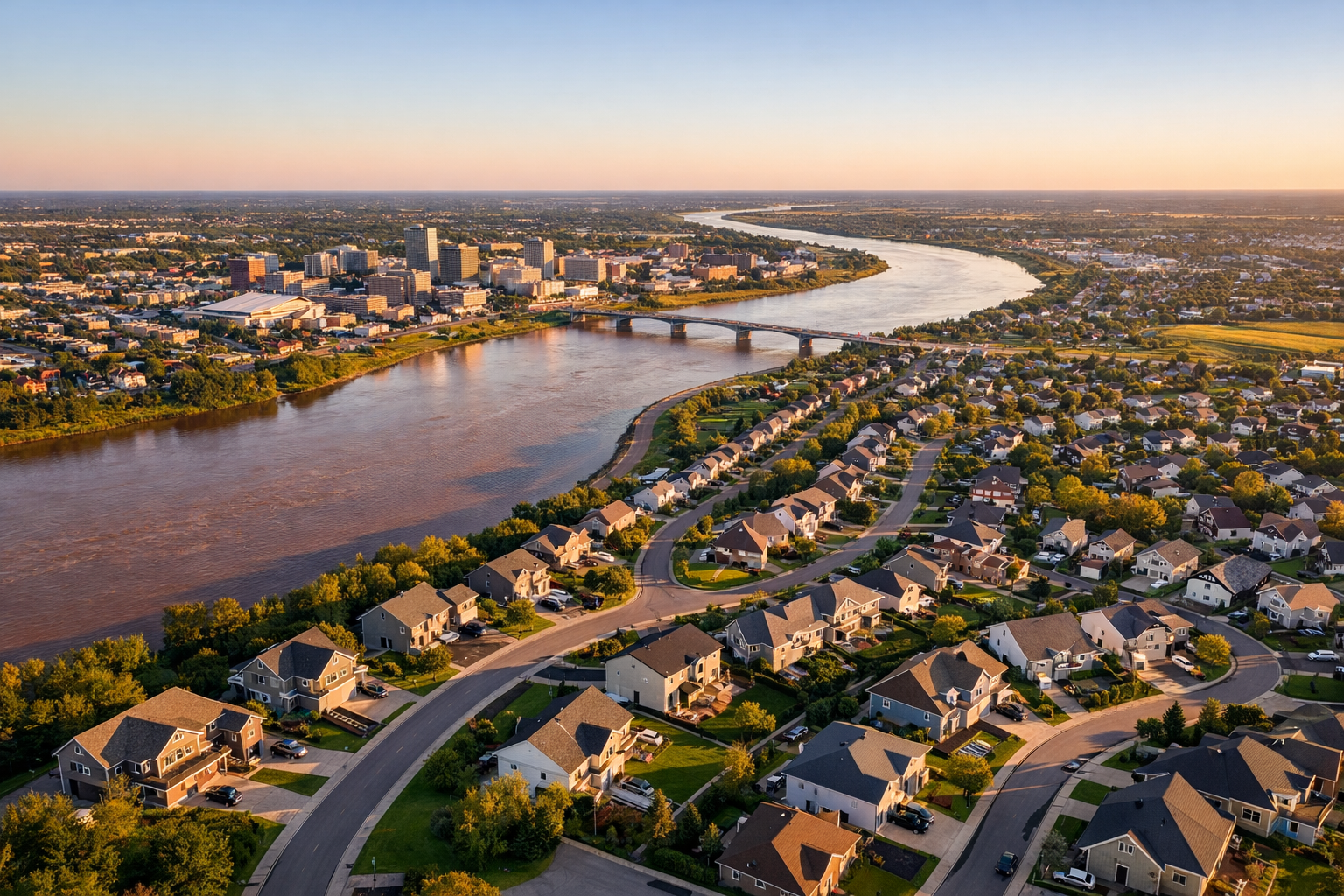
What your Ontario sale actually buys here
The MLS Home Price Index benchmark is the cleanest way to compare two markets, because it prices a typical home rather than averaging whatever happened to sell that month. For July 2026:
- Greater Toronto Area benchmark: $934,600
- Hamilton and Burlington benchmark: $729,800
- Ottawa benchmark: $634,000
- Moncton and Area benchmark: $384,300
Against the GTA that is a gap of about $550,000. Against Ottawa it is about $250,000. Those are not small differences in lifestyle, they are differences in what the rest of your life looks like. A Toronto seller who buys a typical Moncton home outright is left with roughly half a million dollars that was previously locked in drywall.
The point worth sitting with is not that houses are cheap here. It is that the money you free up is the actual asset. What you do with $550,000 matters more than the house you buy with the other $384,000.
The closing cost nobody budgets for
This is where Ontario buyers are usually surprised in a good way, and it is also where a lot of published advice about New Brunswick is simply wrong.
New Brunswick charges a flat 1% Real Property Transfer Tax. Not a graduated scale. One percent, applied to the greater of the purchase price or the assessed value, unchanged since April 2016. On a $384,300 purchase that is about $3,800.
Now price the same moment in Ontario. On a $1,000,000 purchase, provincial Land Transfer Tax is about $16,500. Inside the City of Toronto the Municipal Land Transfer Tax applies on top at the same graduated rates, taking the total to about $33,000.
So the transaction itself costs about $29,000 less in Moncton than in Toronto, and roughly $12,500 less than elsewhere in Ontario. That is money that never appears in a listing price comparison, and it lands on closing day.
One correction worth stating plainly, because the wrong version circulates widely and appeared in an earlier version of this guide: New Brunswick does not charge 1% on the first $250,000 and 1.5% on the balance. That is somebody importing Ontario's bracket structure onto a province that does not have one. The rate is flat.

Property tax, and the trap that catches people who move in stages
New Brunswick property tax has two layers, and understanding the second one is worth real money.
The municipality sets its own rate. For 2026, all three Greater Moncton municipalities held theirs flat: Moncton at $1.3614 per $100 of assessment, Dieppe at $1.3650, Riverview at $1.3826. On a $384,300 home in Moncton that is about $5,200 a year.
The province then charges an additional residential rate of $0.5617 per $100. Here is the part that matters: if the home is your principal residence, the Residential Property Tax Credit reduces that provincial rate to zero on the first half hectare. You pay the municipal rate only.
If it is not your principal residence, you pay it. On that same $384,300 home, the provincial layer adds about $2,150 a year, taking the bill to roughly $7,400.
This catches people who relocate in stages. If you buy here in the spring, keep working in Ontario until the fall, and the New Brunswick house is not yet your principal residence, you are exposed to the higher rate for that period. It is entirely legitimate and entirely avoidable, but only if you plan the sequence deliberately rather than discovering it on your first tax bill.
For context on how those bills compare, average municipal taxes on a two storey single detached home in 2025 ran about $7,500 in Toronto, $7,400 in Mississauga, $6,800 in Hamilton and $5,500 in Ottawa. A principal residence in Moncton at about $5,200 sits below all four, on a house worth a fraction of the price.
Resist the urge to compare tax rates across the two provinces. Ontario rates apply to assessed values frozen at 2016 levels, while New Brunswick assesses closer to current market value with a 10% annual cap on increases. The rates are not measuring the same thing. Compare the dollars. If you want the detail on how New Brunswick assessments are moving, we covered the 2027 phase in here.
Where the gap is smaller than you think
Any guide that tells you everything is cheaper here is selling you something. Energy is the honest exception.
New Brunswick households spent an average of about $2,500 on electricity in 2023, against about $1,300 in Ontario. Nearly double. The reason is structural: electricity is about 88% of household energy here, against 34% in Ontario, because most homes in this province heat with electricity while most Ontario homes heat with natural gas.
Look at total home energy though, and the picture evens out. Water, fuel and electricity combined came to about $3,300 in New Brunswick against about $3,200 in Ontario. A little over $100 a year apart. Ontario is not cheaper on energy overall, it just splits the bill across two utilities instead of one.
What this means practically: when you view a house here, the heating system is a real financial variable, not a footnote. A heat pump versus baseboard electric is a meaningful annual difference in a province where the electric bill carries the whole load. Ask for twelve months of actual bills.
Buying from fourteen hundred kilometres away
Remote purchases are routine here now, and the process is well worn.
Offers go in on standard New Brunswick forms with conditions written in, typically five to ten business days for inspection and financing on a resale property. The deposit is paid on firm acceptance and held in trust. Closing usually runs 30 to 60 days from accepted offer on resale. New construction varies widely, and on a pre construction or early build purchase it can stretch to six or twelve months, so get the occupancy date in writing and understand what happens if it moves.
The practical constraint is not paperwork, it is that you cannot walk the street at nine at night or notice that the basement smells different after rain. That is what your agent is for on a remote purchase, and it is reasonable to expect video walkthroughs of anything you are serious about, including the parts nobody photographs.

Choosing where to land
Most people arriving from Ontario are deciding between Moncton, Dieppe and Riverview without much basis for the choice, and the tax rates above are close enough that they should not drive it.
What should drive it is commute, schools and language. Dieppe is majority francophone and its school catchment reflects that, which is a genuine advantage for some families and a genuine adjustment for others. Riverview sits across the river and trades a few minutes of drive time for a quieter, more established feel. Moncton itself carries the employment base and the widest range of housing stock and price points.
None of that is visible from a listing site, and it is the part worth spending a phone call on before you narrow your search.

Who is actually moving here, and what that means for you
In the most recent year of published data, Greater Moncton grew faster than every metropolitan area in Canada except Edmonton. The population reached 196,143 as of July 2025, up 2.9% in a single year against an average of 1.0% across all 41 Canadian metropolitan areas. Over four years the region added 34,767 people, a gain of 21.5%.
Every agent in this market quotes those numbers. Almost nobody breaks them down, and the breakdown is the part that should shape your decision.
| Where Greater Moncton's growth came from | People |
|---|---|
| Permanent immigrants | +5,728 |
| Net non-permanent residents | +402 |
| Births minus deaths | +125 |
| Net emigration | −119 |
| Net migration within New Brunswick | −107 |
| Net migration from other provinces | −363 |
| Total change | +5,666 |
Moncton census metropolitan area, 1 July 2024 to 1 July 2025. Source: Statistics Canada, Table 17-10-0149-01. Population estimates are from Table 17-10-0148-01, released 14 January 2026. Ontario to New Brunswick migration figures are from Table 17-10-0022-01.
Read that column carefully. Greater Moncton took in 5,728 permanent immigrants in a year when its total net gain was 5,666. Immigration alone was larger than the entire increase. Natural increase, births minus deaths, came to 125 people in a region of nearly two hundred thousand. And the net exchange with other Canadian provinces was negative, with 363 more people leaving for elsewhere in Canada than arriving from it.
Which brings us to the part that is specifically about you.
The Ontario wave already crested
In the year ending June 2022, 9,895 people moved from Ontario to New Brunswick. That was the largest Ontario to New Brunswick flow in 47 years, and it is the period nearly all of the "everyone is leaving Ontario for the Maritimes" coverage was written about.
In the year ending June 2025, the figure was 5,528, down from 8,915 the year before. That is a 38% fall in twelve months. The net gain to New Brunswick, once you subtract the people moving the other way, fell from 5,483 to 1,710, a drop of 69%.
The migration you have been reading about was real. It is also mostly finished.
Why that is good news rather than bad
Had you made this move in 2021 you would have been one of roughly ten thousand Ontarians arriving in New Brunswick that year, competing for homes in a Moncton market holding 2.2 months of inventory. People waived inspections and wrote letters to sellers. A fair number of them overpaid.
Arriving now is a completely different transaction. Half as many Ontario buyers are coming to the province. Greater Moncton is carrying 6.2 months of inventory as of August 2026, matching 2018 for the loosest August reading in eight years. The single detached benchmark is down 6.3% over three months. The average sale is closing 3.4% under asking, and homes are taking a median of 47 days to sell.
You get inventory, time and negotiating room, which is precisely the combination the 2021 arrivals did not get.
And underneath that softer buying window, the structural demand has not gone anywhere. A region adding people at nearly three times the national metropolitan rate, driven by immigration rather than a one-off pandemic reshuffle, is a very different long-term proposition than a town that grew because of a temporary trend. The wave you missed was the competition. The growth is still running.
One note on sourcing, because it matters this year. The 2026 Census was taken in May 2026, but Statistics Canada does not publish population counts from it until 10 February 2027. Every "Moncton population 2026" figure in circulation right now, including the ones on this page, is a postcensal estimate rather than a census count. If someone shows you a 2026 census population for Moncton, it does not exist yet.
What the market is doing while you decide
Moncton is not a runaway market in 2026, and that is useful information if you are planning a move rather than chasing an entry point.
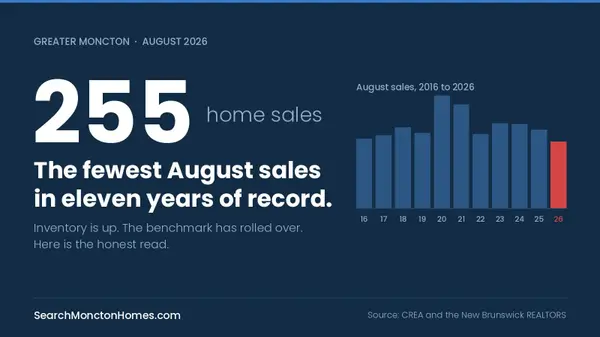
August 2026 sales came in at 255 units, the fewest in the eleven years CREA publishes for this region. New listings rose 7.5% to 461, the second highest August in that same series. Active listings reached 1,585 and months of inventory climbed to 6.2, up from 5.0 a year earlier. The MLS benchmark price is $378,700, still 4.4% above last year but down 6.3% over three months. The average sale price fell 3.5% and the median fell 1.6%.
Read together, that is a market with more supply, materially fewer sales, and prices that have come off their spring peak. For a buyer arriving with Ontario equity, that is a considerably better environment than the one that existed here two years ago. Our full read on the August release is here.

The bottom line
The price gap is real and it is roughly half a million dollars against the GTA. The transaction costs about $29,000 less. The property tax bill is lower in absolute dollars than every major Ontario city, provided you get the principal residence status right. Energy will cost you slightly more, not less.
The decision that actually matters is not whether to move, it is what you do with the equity the move releases, and whether you sequence the purchase so you are not paying the provincial property tax layer for six months unnecessarily. Both of those are planning questions, and both are much easier to answer before you list in Ontario than after.
If you are starting the search, the current inventory across the region is on the map search. If you still own in Ontario and want to know what your equity actually translates to here, a home valuation on this end is the place to begin. The broader practical guide to settling in, including licences, health care registration and the first few months, is in our relocating to New Brunswick guide.
Planning a move to southeastern New Brunswick? The difference between a good outcome and an expensive one is usually sequencing, not luck. Candace McKay works with out of province buyers relocating to Moncton, Dieppe, Riverview and the surrounding communities, and is happy to walk through the numbers for your specific situation. Reach out here and Candace will personally get back to you.
About Candace McKay. Candace McKay is a REALTOR® serving Moncton, Dieppe, Riverview and the surrounding communities of southeastern New Brunswick. She works with local move-up buyers, sellers and out-of-province clients relocating to the region, with a focus on pricing strategy grounded in sub-market data rather than regional averages.
Data sources: MLS Home Price Index benchmarks for July 2026 are per CREA board statistics for the Toronto Regional Real Estate Board, the Cornerstone Association of REALTORS, the Ottawa Real Estate Board and the New Brunswick Real Estate Board Moncton and Area package. Moncton and Area activity figures are from the same July 2026 board package. Ontario Land Transfer Tax rates are per the Government of Ontario and the City of Toronto Municipal Land Transfer Tax schedule effective April 1, 2026. The New Brunswick Real Property Transfer Tax rate of 1% is per the Real Property Transfer Tax Act, section 2, in force since April 1, 2016. Provincial and municipal property tax rates are per the Government of New Brunswick and each municipality's own 2026 budget release. Ontario municipal tax dollar comparisons are 2025 figures from the City of Ottawa 2026 Tax Policy report. Household energy spending is Statistics Canada Table 11-10-0222-01 for 2023 and energy mix is Table 25-10-0060-01 for 2021, the most recent releases available. Tax treatment depends on individual circumstances and this article is general information, not financial, legal, tax or investment advice. Confirm your own position with your lawyer or accountant before acting. Images are illustrative.
Categories
Recent Posts