Your Dieppe Property Tax Freeze Ends in 2027. The Increase Is Capped.
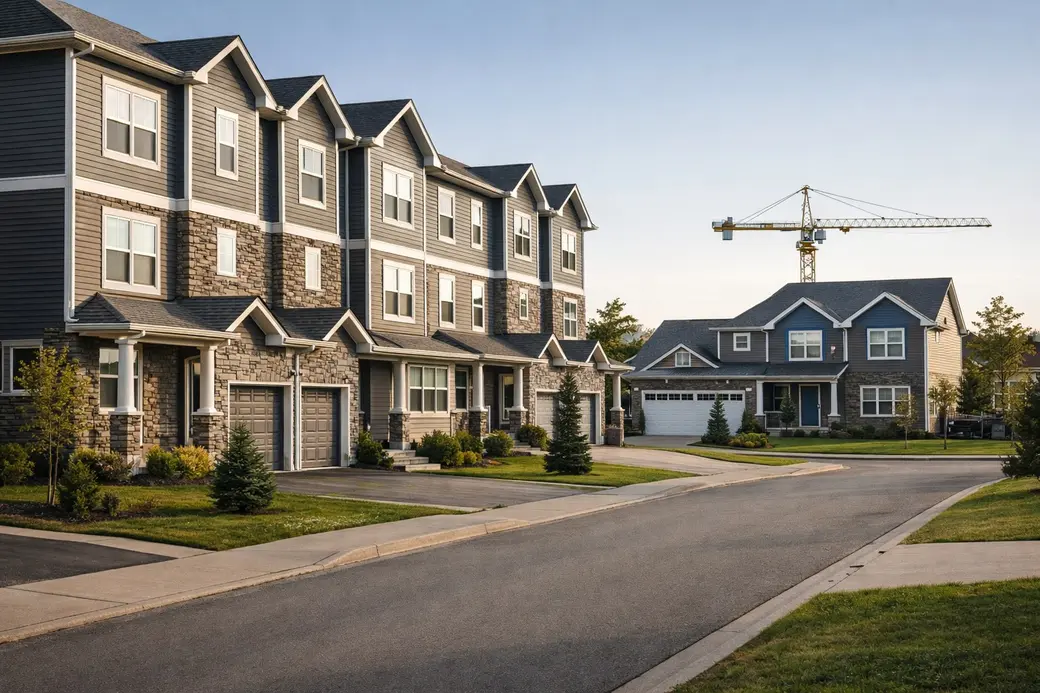
If you own property in Dieppe, your 2026 tax bill probably looked a lot like your 2025 one. That was deliberate. The province froze the value used to calculate property taxes for the 2026 taxation year, holding roughly 430,000 New Brunswick properties at their 2025 level.
Most of the coverage treated that as the story. It is not. The freeze is a one year timing measure. The policy that actually determines what you pay for the rest of the decade starts in 2027, and almost nobody is reading their assessment notice closely enough to see it coming.
What the freeze actually did
For the 2026 taxation year, about 90 percent of New Brunswick property owners saw no change in their value for taxation. The exceptions are specific: a sale or transfer, new construction or major improvement, a change in use or classification, a correction of an assessment error, previously omitted property, and any property whose value went down.
You can see the freeze in the provincial totals. The 2026 assessment base for taxation came in at $99.8 billion, up 2.7 percent or $2.7 billion. The year before, the base was $97.2 billion after an 8.7 percent jump. The freeze is the difference between those two growth rates. It did not make value disappear. It parked it.
The number that matters is on your notice, not your bill
Here is the part that gets missed. Service New Brunswick never stopped assessing property at real and true market value. It simply stopped applying that number to your taxes for one year.
Your assessment notice carries both figures. There is a value for taxation, which is what your bill was calculated on, and there is a real and true market value, which is what the province believes your property is actually worth. For most Dieppe owners who have not sold or renovated since 2025, those two numbers are no longer the same.
The gap between them is not an accounting curiosity. It is a pre-committed increase to your carrying cost, already calculated, already on file, waiting for a date.
2027 does not snap back, it steps up
This is where the widespread assumption is wrong, and where the planning actually happens.
Beginning in the 2027 taxation year, Service New Brunswick applies a spike protection mechanism that limits assessment increases to 10 percent per year, with larger increases phased in over time. Recent sales, new construction and major improvements are excluded, because those properties are already sitting at market value. The province describes the intent as a more predictable, transparent, stable and fair system for 2027 and beyond.
So the gap does not arrive as a single hit. It arrives as an escalator.
Take a Dieppe home currently taxed on $320,000 with a real market value of $400,000, at the city's 2026 municipal rate of $1.3650 per $100. Under a full snap back, the bill would jump from $4,368 to $5,460 in one year. Under the cap, it does not.
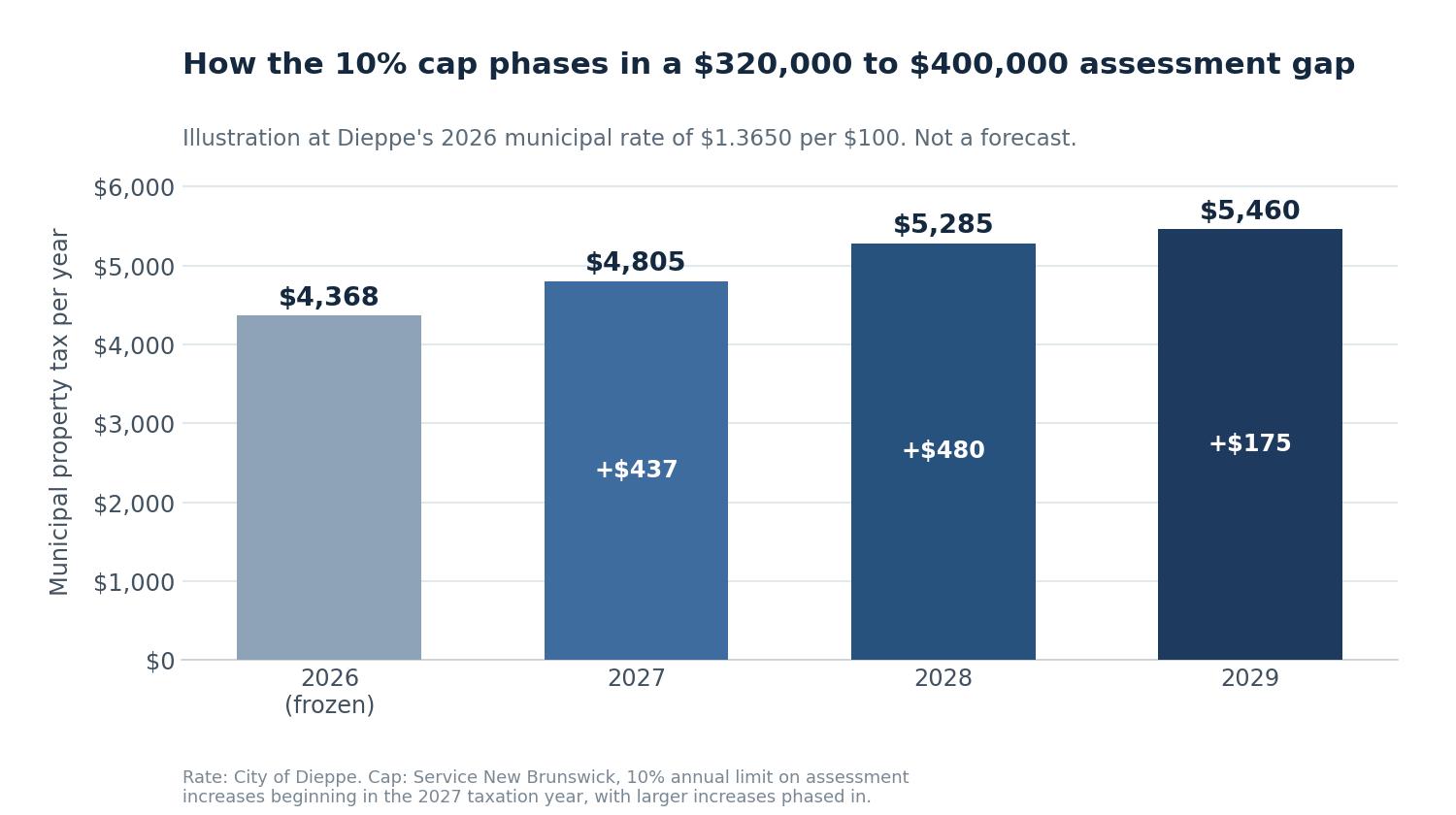
The first increase is about $437, or roughly $36 a month. The second is about $480. By the fourth year the property reaches market value and the increases stop. Same destination, three steps instead of one cliff.
That is a meaningfully different planning problem. A single $1,092 shock is something you absorb. A three year escalator is something you budget, and something a buyer should be pricing into an offer today.
Where you sit changes what you do
If you own in Dieppe and are staying put. Pull your 2026 notice and subtract the value for taxation from the real and true market value. Divide the gap by ten. That is approximately your first annual step, and it repeats until the two numbers converge. For most owners this is a manageable number, but it is a known number, which is better than a surprise. Build it into your carrying cost from now, not from 2027.
If you are buying in Dieppe. The tax figure on a listing is currently understated for any property that has not changed hands since 2025. It reflects a frozen value, not what you will be paying in three years. Ask for the seller's assessment notice and read both lines. Model your monthly cost against the market value, not the frozen one. This is the single most common carrying-cost error being made in this market right now, and it is entirely avoidable.
If you are selling in Dieppe. The freeze flatters your numbers. Low property taxes make your carrying costs look better than the steady state, and a well-advised buyer will discount for it. Do not build a pricing argument on a figure that has a public expiry date. Lead with something durable instead.
If you bought or renovated recently. You were reassessed at the transaction or the improvement, freeze or not. That felt like bad luck at the time. It is not. You are already at market, which means no escalator, and your tax figure is the honest one on the street. When you eventually sell, that is a real advantage over a neighbour whose bill is about to climb for three straight years.
The bottom line
The freeze was the right call for one year. Reassessing every home at peak market value in a single pass would have created a shock disconnected from any change in municipal services. What replaced it matters more: a cap that trades a cliff for a slope.
Note also that the rate is not the variable here. Dieppe's 2026 municipal rate is $1.3650 per $100 and Moncton's is $1.3614. That difference is worth about $14 a year on a $400,000 home. Your assessed value, and the gap sitting on your notice, will move your bill by many multiples of that. Watch the value, not the rate.
There is a deadline to request a review of your assessment and it falls early in the calendar year. The exact date is printed on your notice. If you think the market value on file is wrong, that window is the only place to say so, and it closes long before the bill shows up.
If you want to understand where your property actually sits against current market value rather than against a frozen figure, start with a current home valuation. If a sale is on the table in the next couple of years, the selling process page covers how timing gets decided.
Thinking about buying or selling in Dieppe? The gap between a frozen assessment and real market value is different on every street and in every price band, and it changes what a property actually costs to hold. Candace McKay works with buyers and sellers across Dieppe, Moncton and Riverview and can walk you through what your notice is really saying. Reach out here and Candace will personally get back to you.
About Candace McKay. Candace McKay is a REALTOR® serving Moncton, Dieppe, Riverview and the surrounding communities of southeastern New Brunswick. She works with local move-up buyers, sellers and out-of-province clients relocating to the region, with a focus on pricing strategy grounded in sub-market data rather than regional averages.
Data disclaimer: The 2026 assessment freeze, the 90 percent coverage figure, the exceptions, the 10 percent spike protection cap beginning in 2027 and the provincial assessment base figures are per Service New Brunswick and the Government of New Brunswick. The Dieppe municipal tax rate of $1.3650 per $100 is per the City of Dieppe and the Moncton rate of $1.3614 is per the City of Moncton. The phase-in figures shown are an arithmetic illustration at a fixed rate, not a forecast, and assume no change to municipal rates. Your own assessment, exemptions and review deadline are specific to your property and appear on your notice. This article is general information, not financial, legal or tax advice.
Categories
Recent Posts