Bank of Canada Holds at 2.25%: What It Means for Moncton Buyers and Sellers

The Bank of Canada held its overnight rate at 2.25% on September 2. For anyone buying, selling, or renewing a mortgage in Greater Moncton, the practical signal is that relief is not arriving on schedule, and the market has stopped pricing in further cuts.
This is not a neutral hold. The Bank pointed to new US tariffs, Canadian counter-measures, and persistently higher gasoline prices as costs that could feed into consumer prices over time. CPI has hovered around 3% in recent months. Core inflation sits closer to the 2% target, with inflation excluding gasoline at 2.2% in July. For a market like Moncton, where the average resale price sits at about $384,000 and sales volume is already thinning, that changes the math for buyers, sellers, and anyone facing a renewal.
The Bank has stopped signalling cuts, and two major Canadian banks now forecast a hike at the October meeting. That shift in posture matters more to Moncton's fall market than the hold itself.
What the Bank of Canada Actually Decided
On September 2, the Bank left its overnight rate at 2.25%, with the Bank Rate at 2.5% and the deposit rate at 2.20%.
The decision came alongside GDP growth of 3.3% in the second quarter, a rebound from a weak first quarter, with gains across consumption, exports, and business investment. Unemployment edged down to 6.4% in July, though the Bank noted that demand for labour remains subdued and indicators still point to excess supply. These are not the conditions that produce urgent rate cuts.
The Bank did not signal a hike. What it said was that it is prepared to adjust monetary policy as needed, and it flagged the tariff environment as a cost pressure that could reach consumers. The next decision is October 28, and it arrives with an updated Monetary Policy Report. Two major Canadian banks are forecasting an increase at that meeting.
Why It Matters for Real Estate in Moncton
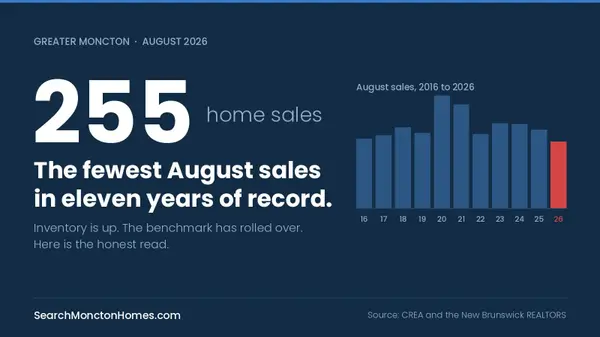
Greater Moncton home sales fell 5.1% year over year in July 2026, with 316 transactions. Provincially, the single-family benchmark price was $345,500, up 6.9% from a year earlier, and New Brunswick sales totalled 970 units, down 8.7%.
Greater Moncton has not followed the provincial price curve. The local average price is essentially flat, down 0.5% from a year ago, and the MLS Home Price Index composite is up just 0.1%. Months of inventory sat at 4.9 in July, against 4.5 a year earlier and 3.6 in 2024. Flat prices, thinning sales, and rising inventory is what a market looks like when it has stopped being seller-dominant and has not yet settled into whatever comes next.
The rate hold keeps current borrowing costs in place. On a home at about $384,000 with 10% down, a five-year fixed rate near 4.5% works out to roughly $1,910 a month on a 25-year amortization. Anyone on a variable rate, or renewing in the next several months, carries the risk that this number moves before they lock it in.
The renewal pressure is real and national. CMHC has flagged that a large share of Canadian mortgages come up for renewal across 2025 and 2026, and most of those were originally written at rates well below today's. Delinquencies remain low by historical standards, but they have been drifting upward rather than downward.
What It Means for Buyers and Sellers
For buyers, the calculus is straightforward but uncomfortable. Waiting for lower rates is now a bet against the Bank's own guidance. If you are pre-approved and a property works financially today, the risk of delay is that your borrowing power shrinks rather than grows. Use the mortgage calculator to stress-test your budget against a rate 50 to 75 basis points above your current quote.
For sellers, the pool of motivated buyers is narrowing but not closed. Greater Moncton remains affordable relative to most Canadian metros. But with inventory up and prices flat, this is not a market that rewards aspirational pricing. Homes priced against recent comparable sales are moving. Homes priced against what a neighbour got eighteen months ago are sitting.
For those renewing, the most useful move available right now is a rate hold. Most lenders offer 90 to 120 days, which covers the October 28 decision. If you are on a variable rate, run your payment against a scenario 75 basis points higher and see whether it still works.
Local Insight
The conventional read is that a rate hold is neutral. In practice this one is mildly negative for anyone who was counting on cheaper money to fix affordability. The Bank's posture has moved from cutting to waiting, and two major banks think the next move is up. Most buyers and sellers have not repriced that yet.
Greater Moncton has a structural cushion here. Even at current rates, a typically priced home in this market carries a monthly payment far below the equivalent in Halifax or Toronto, which is exactly why interprovincial buyers keep finding it. But affordability is not immunity. If five-year fixed rates push past 5%, that same $384,000 home on a 25-year amortization climbs to roughly $2,060 a month. That is about $150 more, every month, for the same house.
The move right now is to act on information rather than hope. Get a rate hold. Run the numbers at today's rate and at 75 basis points higher. If the purchase works at both, you have a margin of safety. If it only works at the lower rate, you are speculating, and the Bank has just told you which way it is leaning.
Ready to Make a Move?
Whether you are buying, selling, or just running the numbers, good data matters more in a rate environment like this one.
- Browse homes for sale in Greater Moncton
- Check your home value
- Read the Buyers Guide
- Use the Affordability Calculator
- Get in touch with our team
Disclaimer: This post references mortgage rates, payment estimates, and economic data for information only. Rate and economic figures are from the Bank of Canada's September 2, 2026 announcement. Sales and price figures are from CREA and the New Brunswick Real Estate Association for July 2026: Greater Moncton 316 sales and an average price of $383,611, New Brunswick 970 sales and a single-family benchmark of $345,500. Payment estimates assume 10% down on a 25-year amortization and exclude mortgage insurance, taxes, and fees. Consult a licensed mortgage professional for advice specific to your situation.
Categories
Recent Posts