Moncton Just Committed $25 Million to Unlock 1,300 Homes. Owners Should Read the Fine Print.
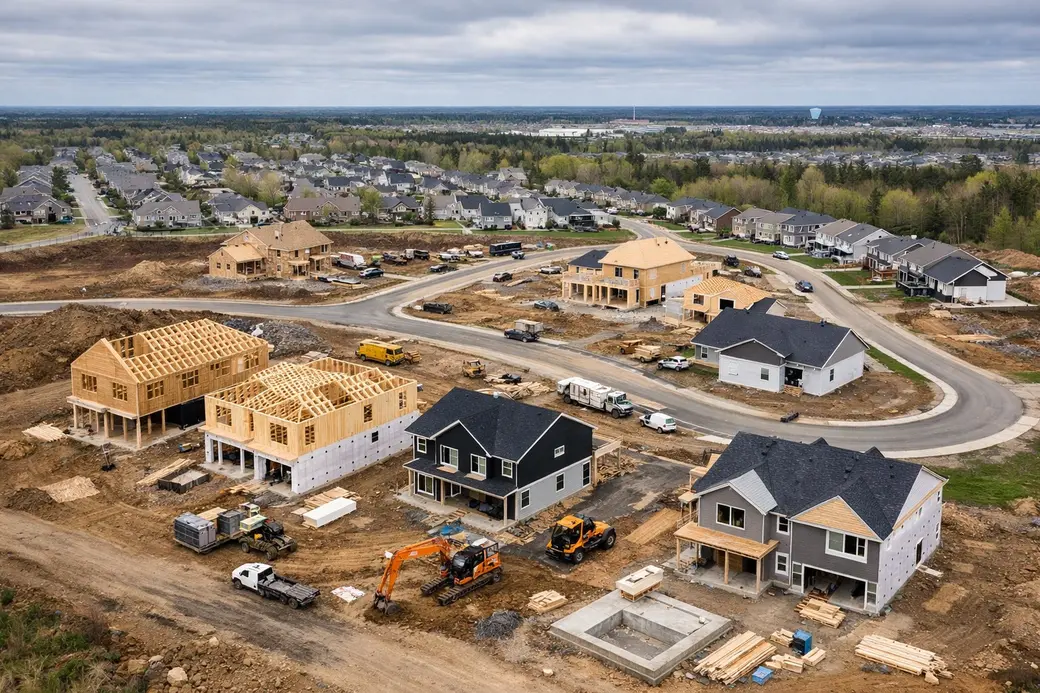
On August 11, 2026, three levels of government committed more than $25 million to a stretch of Elmwood Drive. The federal share is $9.6 million through the Canada Housing Infrastructure Fund, the province is putting in close to $8 million, and the City of Moncton is covering more than $7.5 million.
The money expands sanitary sewer capacity, builds new stormwater infrastructure, and rebuilds the roadway to four lanes with an integrated multi-purpose trail. The stated purpose is to unlock up to 1,300 new housing units.
Most of the local coverage led with the dollar figure. The dollar figure is the least interesting part. The number that matters to anyone who owns a house in Moncton, or is about to buy one, is 1,300, and what it says about the direction city hall has chosen.
What was actually announced, and what was not
Worth being precise, because two separate Elmwood Drive projects are running at once and they are easy to confuse.
The first is already underway. The City is doing a full road reconstruction on Elmwood Drive between Lewisville Road and Massey Avenue, running from mid-May to late fall 2026. That work covers roughly 505 metres of watermain, 185 metres of storm piping, 300 metres of sanitary line renewal, and new traffic signal infrastructure. It is renewal of aging pipe, not expansion, and it does not create development capacity.
The second is the August announcement. That one is about capacity. Expanding sanitary sewer means the system can carry more households than it can today, which is the actual constraint on where housing gets built in this city. Pipe capacity, not zoning, is usually what decides whether a parcel is developable.
What the announcement did not include is equally worth noting. The release named neither the exact segment limits nor a construction start date. Mayor Shawn Crossman described it as "a critical and necessary investment in a growing area of our city," which is true and also not a map. Until the City publishes the limits and the schedule, nobody can tell you precisely which parcels get serviced first or when the first shovel goes in. Anyone who tells you otherwise is guessing.
There is separate context that points north. The City and the provincial Department of Transportation and Infrastructure have already studied Elmwood Drive from McLaughlin Drive to the northern city boundary, along with McLaughlin Drive south to Granite Drive, and produced a conceptual improvement plan costed at roughly $40 million in current dollars, excluding land acquisition, transit and any TransCanada interchange work. That study exists because the corridor is where the city's growth pressure is. Treat that as context, not as confirmation of the August project's limits.
The pattern this fits into
Take the Elmwood money on its own and it is one road project. Put it beside what Moncton has already committed to and it stops looking like a one-off.
Under its Housing Accelerator Fund agreement, Moncton took more than $15.5 million from Ottawa in exchange for fast-tracking over 490 housing units within three years, with a stated expectation of spurring more than 5,500 homes over the following decade. The commitments attached to that money included permitting four units as of right across all residential zones, grants for missing-middle development and accessory dwelling units, support for non-profit developers, and revisions to parking, height and design standards.
Then the 2026 budget. Moncton is running a $236 million operating budget with the residential tax rate held flat at $1.3614 per $100 of assessment, against a $92 million capital budget that includes $27.5 million for roads and traffic infrastructure and $20.2 million for water, sewer and storm systems.
Zoning reform, then trunk capacity, then $25 million of pipe and pavement aimed at 1,300 units. That is not three unrelated announcements. That is a city systematically removing the physical and regulatory constraints on housing supply, in the correct order.
As policy it is close to textbook, and Moncton deserves more credit for it than it gets. As a signal to anyone who owns property here, it is a different conversation.
Supply does what supply does
Here is the part that does not make it into the press release.
In July 2026, the Moncton and Area board recorded 316 sales, down 5.1 percent year over year. The average sale price was $383,611, down 0.5 percent. The MLS Home Price Index composite benchmark, which controls for the mix of what actually sold, was $384,300, up 0.1 percent. Prices did not fall. They stopped moving.
The conditions behind that flat print are the interesting part. Months of inventory across the board sat at 4.9, up from 4.5 a year earlier, 3.6 in 2024 and 2.2 at the peak of the 2021 squeeze. Median days on market moved to 38 from 33. The sale to list price ratio slipped to 97.0 from 97.9, meaning the average seller is now taking three percent under ask instead of two.
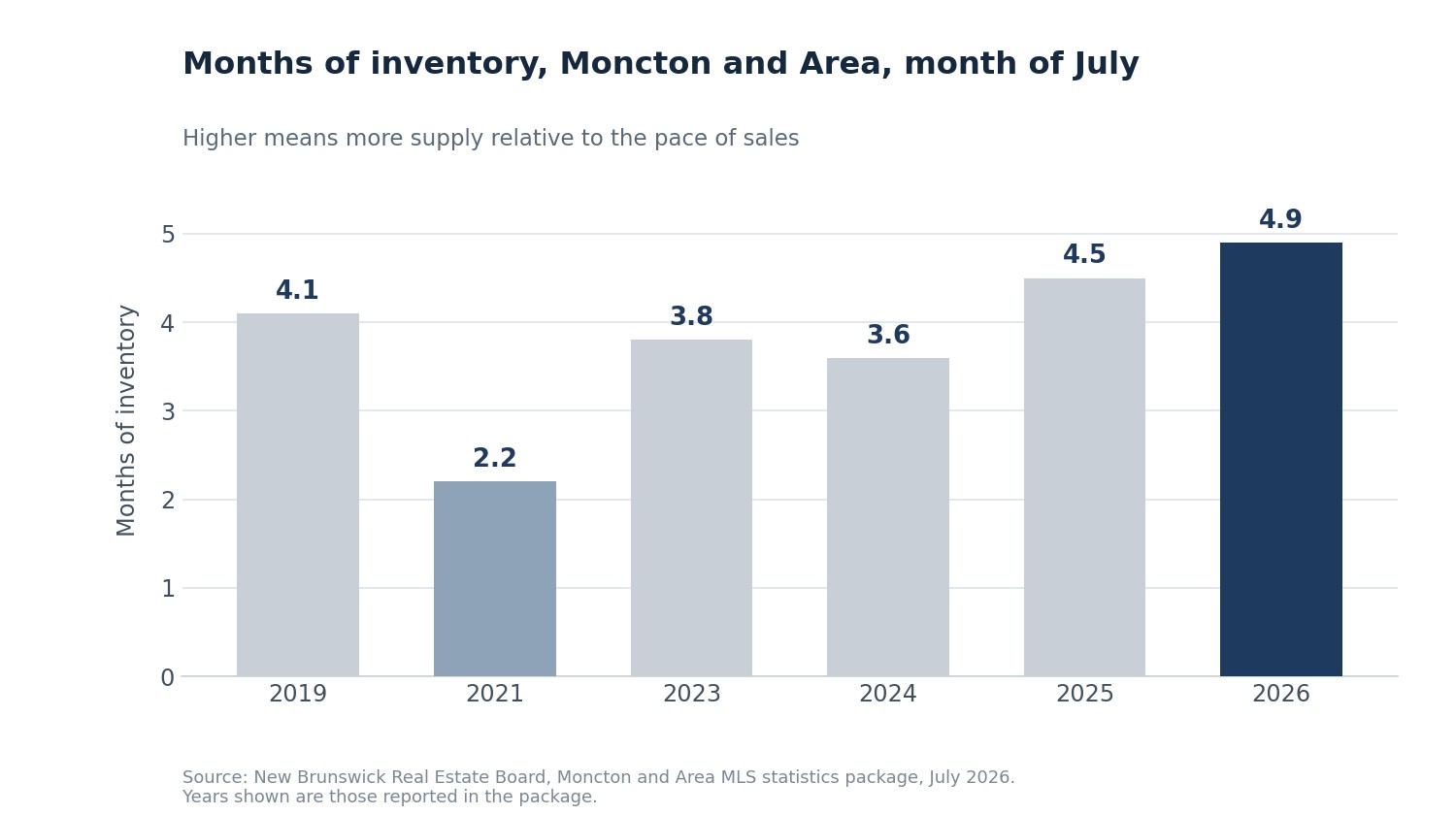
None of those four numbers is dramatic on its own. Together they describe a market that has handed a measurable amount of leverage back to buyers over twenty-four months, and the direction has been consistent, not noisy. This is what the front edge of a supply response looks like, before any of the 1,300 units exists.
Moncton's neighbours are running a different playbook. Riverview's 2026 capital budget is $43.5 million and $34.7 million of it is a single recreation complex. That is a town buying amenity. Dieppe faces a harder constraint, limited remaining serviced land in the subdivisions people actually want. Amenity and scarcity both push price up. Supply pushes it sideways.
Provincewide the same loosening is visible. Active listings across New Brunswick reached 4,124 in July, up 5.3 percent, a level CREA notes has not been seen in the month of July in more than five years, and months of inventory moved to 4.3 from 3.7 a year earlier. Prices are still rising, with the composite benchmark at $344,000, up 6.7 percent. But the squeeze that drove 2021 through 2024 has loosened, and it has loosened locally as well as provincially.
The demand side has a crack in it
Adding supply is only unambiguously good if demand holds. This is the part worth watching, and almost nobody locally is saying it out loud.
Moncton's growth story is real. Statistics Canada estimated the Moncton census metropolitan area grew 2.9 percent in the year to July 1, 2025, the second fastest of Canada's 41 census metropolitan areas, behind only Edmonton at 3.0 percent and tied with Calgary. The national CMA average was 1.0 percent. On that basis, 1,300 units is not speculative overbuilding. It is catching up.
But look at where the growth came from. Net interprovincial migration to Moncton was negative 363 over that period, and every Atlantic CMA hit its lowest interprovincial figure in at least four years. The wave of Ontarians and British Columbians who drove the 2021 to 2023 run-up has stopped arriving, and on net is now leaving. What is holding the growth rate up is international migration.
That makes Moncton's demand curve more dependent on federal immigration policy than it has been at any point in the last decade. It is a single input, set in Ottawa, that can be revised in a budget cycle.
So the honest framing of the Elmwood investment is conditional. If population growth holds near 3 percent, 1,300 units is prudent and probably insufficient. If federal targets tighten while three levels of government are actively financing new capacity, Moncton is adding supply into softening demand, and the price effect of that lands on existing owners, not on the politicians who cut the ribbon.
That is not a prediction. It is the variable to watch, and the next federal immigration levels plan is the thing to watch it in.
What this means depending on which side you are on
If you own in Moncton and plan to sell in the next two years. Your competition is going to increase, not decrease. You are already selling into 4.9 months of inventory and a 38 day median, both of which have moved against sellers for two straight years. Every unit of new supply that comes online between now and your listing date makes your pricing decision less forgiving. Sell into the current market rather than waiting for a rebound in appreciation, because the policy direction of this city is pointed at the opposite outcome. If a sale is on your horizon at all, front-run the pipeline.
If you own in Moncton and are staying put for ten years. None of this should worry you. Serviced land, a four-lane corridor, a trail network and 1,300 neighbours is what a growing city looks like, and the long-run effect on your property value is positive. Short-term appreciation is what gets traded away, not long-term value.
If you are buying in Moncton. You have leverage and a widening runway. Inventory is building, the average seller is accepting three percent under ask, and the pipeline argues that trend continues. Write conditions in. Look at listings sitting well past the 38 day median. The urgency that defined 2021 through 2023 is not the market you are buying in, and pricing your offers as if it were is the most expensive mistake available to you right now.
If you are an investor. The Elmwood corridor is where serviced capacity is being created, and serviced capacity is the binding constraint on development in this city. That is worth understanding well before the segment limits are published, not after. But size the position against the demand risk above rather than against the 2021 to 2023 growth curve, which is not the curve Moncton is on any more.
The bottom line
Moncton has decided to solve its housing problem by building its way out of it. The Elmwood Drive money is the clearest evidence yet, and it follows a zoning reform and a federal funding agreement that point the same direction. That is the right call for the city.
It also means Moncton owners should stop benchmarking their expectations against the 2021 to 2023 run-up, or against neighbouring towns that are constrained by land and boosted by amenity spending. Moncton is a market being deliberately unconstrained. Different policy produces different price behaviour, and the flat July benchmark is the first clear reading of it.
Know which of those two dynamics your house is exposed to before you price it.
If you want to know where your property actually sits against its own sub-market rather than the regional average, start with a current home valuation, and if a sale is on the table in the next couple of years, the selling process page lays out how the timing decision gets made.
Thinking about your next move in Greater Moncton? A $25 million capacity investment aimed at 1,300 units changes the timing calculation for anyone holding property on the Moncton side of the river, and it changes it before a single unit is built. Candace McKay works with buyers and sellers across Moncton, Dieppe and Riverview and can tell you exactly how the supply pipeline affects your street, your price band and your timing. Reach out here and Candace will personally get back to you.
About Candace McKay. Candace McKay is a REALTOR® serving Moncton, Dieppe, Riverview and the surrounding communities of southeastern New Brunswick. She works with local move-up buyers, sellers and out-of-province clients relocating to the region, with a focus on pricing strategy grounded in sub-market data rather than regional averages.
Data disclaimer: Funding figures are per the Government of Canada announcement of August 11, 2026 under the Canada Housing Infrastructure Fund. Housing Accelerator Fund terms are per CMHC. Municipal budget and construction figures are per the City of Moncton. The Elmwood Drive and McLaughlin Drive corridor study figures are per the City of Moncton public engagement materials. Population figures are per Statistics Canada subprovincial population estimates to July 1, 2025. Market figures are from the New Brunswick Real Estate Board Moncton and Area MLS statistics package for July 2026 and from CREA provincial MLS statistics for New Brunswick. The August announcement did not specify project limits or a construction schedule, and this article does not assume any. Market conditions change monthly. This article is general information, not financial, legal or tax advice.
Categories
Recent Posts