Moncton Average Home Price: September 2026 Data
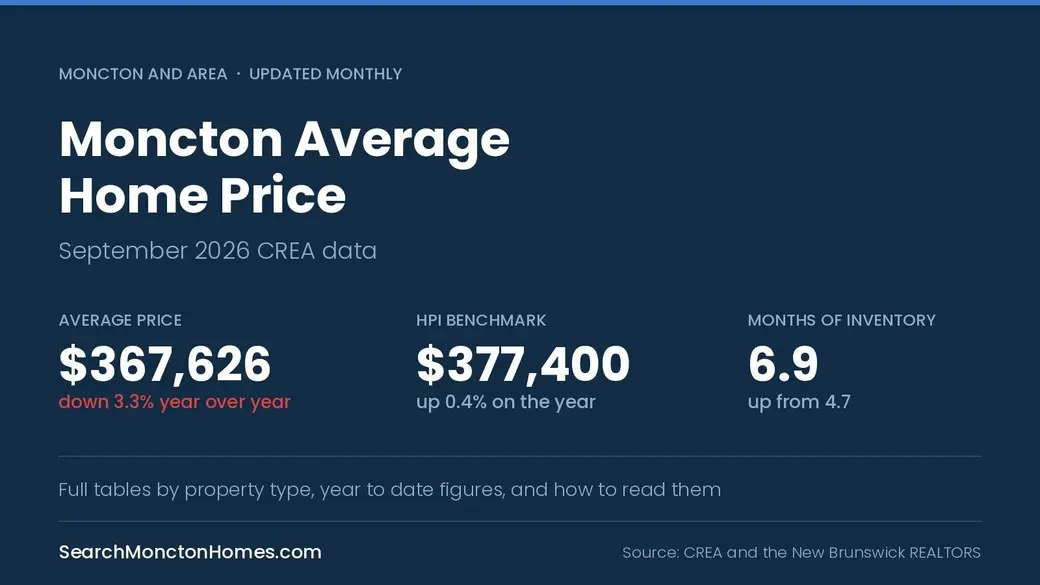
The average home price in Greater Moncton was $367,626 in September 2026, down 3.3% from September 2025. The MLS Home Price Index benchmark, which measures what a typical home is actually worth, was $377,400, up 0.4% over the same twelve months and down 1.7% over the last three.
Prices have levelled off since the spring while sales have fallen sharply. This page sets out what each figure measures, what September 2026 actually showed, and how to read it against your own property.
This page is updated with each new CREA release. Last updated 14 October 2026 with September 2026 data, the most recent available.
September 2026 at a glance
| Metric | September 2026 | Vs September 2025 |
|---|---|---|
| Average price | $367,626 | −3.3% |
| Median price | $360,000 | +1.1% |
| HPI benchmark price | $377,400 | +0.4% on the year, −1.7% on the quarter |
| Sales | 229 | −26.1%, from 310 |
| New listings | 472 | +3.1%, from 458 |
| Active listings | 1,575 | +8.7%, from 1,449 |
| Months of inventory | 6.9 | up from 4.7 |
| Median days on market | 51 | down from 53 |
| Sale-to-list ratio | 96.2% | down from 96.9% |
Source: Moncton and Area MLS Residential Market Activity and MLS HPI Report, September 2026, prepared for the New Brunswick REALTORS by CREA.
Year to date, January through September 2026
| Metric | 2026 to date | Vs 2025 |
|---|---|---|
| Sales | 2,368 | −8.4% |
| Average price | $382,320 | −1.0% |
| Median price | $362,000 | +0.6% |
| New listings | 4,332 | +2.0% |
| Months of inventory | 5.1 | up from 4.4 |
| Median days on market | 39.5 | up from 37.5 |
None of these numbers are your house
A regional average and a benchmark home both describe the market, not your address. In a month when one property type went from scarce to plentiful and another hit a series low in sales, that gap is worth real money. Start with a current valuation.
Takes one address and about a minute. For a closer read on your street or property type, Candace McKay answers directly.
Why the average price and the benchmark price disagree
Average price is the arithmetic mean of everything that sold. It moves when the mix of homes changes, not only when values change. Sell more entry-level homes one month and the average falls, even if every individual house on the street is worth more than it was.
The MLS Home Price Index is built to strip that out. It tracks a constant-quality benchmark home, the same size, age and features month after month, so a change in the index is a change in value rather than a change in what happened to trade.
In September 2026 the three price measures did not agree. The average was down 3.3% year over year, the median was up 1.1%, and the benchmark was up 0.4%. When the average and the median disagree like that, the difference is the mix of what sold. The benchmark is the one to use for value, and it says a typical home is worth about the same as a year ago.
The shorter windows show when the change happened. The benchmark is down 0.3% from August, down 1.7% from three months ago and down 6.3% from six months ago. Six months ago it stood at about $403,000, so roughly $25,000 has come off since the spring. Most of that came off in late spring. Over the last three months the benchmark has moved by only about $6,500.
If you take one thing from this page, take that distinction. Use the benchmark for value questions. Use the average for questions about what the market actually transacted.
Prices by property type
Treating Greater Moncton as one market hides the more useful story. The benchmark and the balance of supply and demand differ sharply by property type.
| Property type | Benchmark | vs 12 months | vs 3 months | Months of inventory |
|---|---|---|---|---|
| Townhouse | $286,800 | +16.8% | +8.1% | 6.6 |
| Semi-detached | $370,300 | +3.2% | −0.9% | 6.2 |
| Composite (all types) | $377,400 | +0.4% | −1.7% | 6.9 |
| Single detached | $386,300 | +0.1% | −2.0% | 6.4 |
| Apartment | $311,800 | −8.9% | −4.7% | 36.0 |
Single detached is where the volume has gone. Detached sales are down 13.2% year to date against a market down 8.4%, and September's 171 detached sales were the lowest September that segment has recorded in the eleven years published. Its benchmark is essentially flat on the year at +0.1%, with 6.4 months of inventory. Detached new listings are down 4.5% year to date, so the pressure is coming from fewer buyers rather than more sellers.
Semi-detached went from the tightest segment to a balanced one in a month. In August it carried 3.2 months of inventory. In September 69 semi-detached homes were listed, the most for any September in the series, and 28 sold, taking inventory to 6.2 months. Year to date, semi sales are still up 17.6% and the benchmark is up 3.2% on the year, but the scarcity is gone. Median days on market for semis was 55 in September, up from 39 a year earlier.
Townhouse carries the strongest index and the thinnest volume. The benchmark is up 16.8% over twelve months, the best figure in the release, but the segment sold 11 homes in September and holds 6.6 months of inventory.
Apartments remain too thin to read. The benchmark is down 8.9% over the year and inventory reads 36.0 months, but that figure is 36 active listings divided by a single sale in September, with 20 year to date. This page will not treat it as a trend.
Prices levelled off. Sales did not.
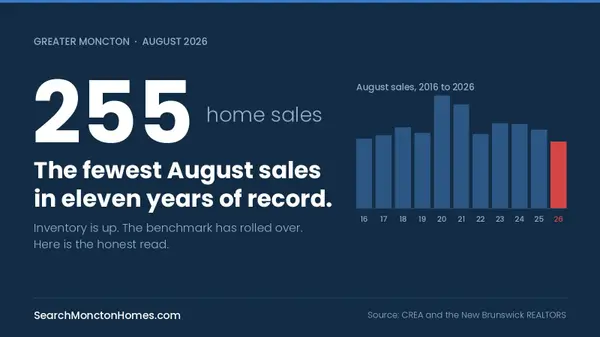
September 2026 recorded 229 sales, the lowest September in the eleven-year series in the release, following the lowest August in the same series. The year-over-year sales decline has deepened with each of the last three releases: down 5.1% in July, 15.3% in August and 26.1% in September.
Supply moved the other way. New listings reached 472, the most for any September in the series, and the sales-to-new-listings ratio fell to 48.5, the lowest September reading in the 2016 to 2026 series. Months of inventory rose to 6.9, the highest September level since 2018.
The benchmark, meanwhile, barely moved, down 0.3% on the month. That combination of falling volume and steady prices looks like a standoff: prices holding, buyers waiting.
None of that is a crash. Active listings are still about a third below their 2016 level, the sale-to-list ratio is 96.2%, and the benchmark is level with a year ago. It is a market where buyers have time and leverage, which was not true two years ago.
What this means if you are buying
Months of inventory is at its highest September level since 2018. Active listings are up 8.7% on the year, months of inventory has climbed from 4.7 to 6.9, and on average sales closed 3.8% under asking.
Watch the benchmark and the inventory figure for the property type you actually want, not the regional average. Semi-detached buyers in particular have considerably more choice than in August, with months of inventory up from 3.2 to 6.2. Our buyers guide walks through the process.
What this means if you are selling
Price to the most recent thirty days of comparable sales, not to spring. The benchmark is about $25,000 below where it stood six months ago, and buyers are comparing your home against 1,575 active listings across all property types, 1,092 of them detached.
Pricing right still works. Median days on market was 51 in September, slightly faster than a year earlier, and detached homes that sold took a median of 46 days. In our experience, the listings that sit are usually the ones still priced against spring comparables.
How to read these numbers
Geographic scope. Every figure here covers Moncton and Area as CREA and the New Brunswick REALTORS define it. That is the Greater Moncton region including Moncton, Dieppe and Riverview and the surrounding communities. It excludes Saint John, Fredericton and the Northern and Valley regions, which are reported separately.
There is no municipal breakdown in this data. The public package reports the region as a single market. Any figure you see attributed to it for Moncton alone, Dieppe alone, Riverview alone, or a named neighbourhood, is not from this source. Treat those numbers, and their source, with care.
Provincial figures are a different market. The New Brunswick REALTORS also publish a province-wide summary. In September 2026 it showed sales down 12.6% and a benchmark up 2.7%, a noticeably stronger picture than Moncton and area. Do not use provincial figures to judge a Moncton property.
Averages are not values. Use the benchmark for value questions and the average for questions about what the market transacted.
Small segments move erratically. Apartments and townhouses trade in low volumes here. Watch the index over several months rather than reacting to a single one.
Data is revised. CREA notes each report is built from the full data set collected on the first calendar day of the month and cannot be compared directly to previously published reports.
For the month-by-month narrative, including charts and what the release means for buyers and sellers right now, read the September 2026 Moncton market update.
Source: Moncton and Area Residential Market Activity and MLS Home Price Index Report, September 2026, prepared for the New Brunswick REALTORS by the Canadian Real Estate Association. Figures are for Moncton and Area. Provincial comparison from the New Brunswick residential housing activity report, September 2026. This page is updated with each monthly release.
Categories
Recent Posts